
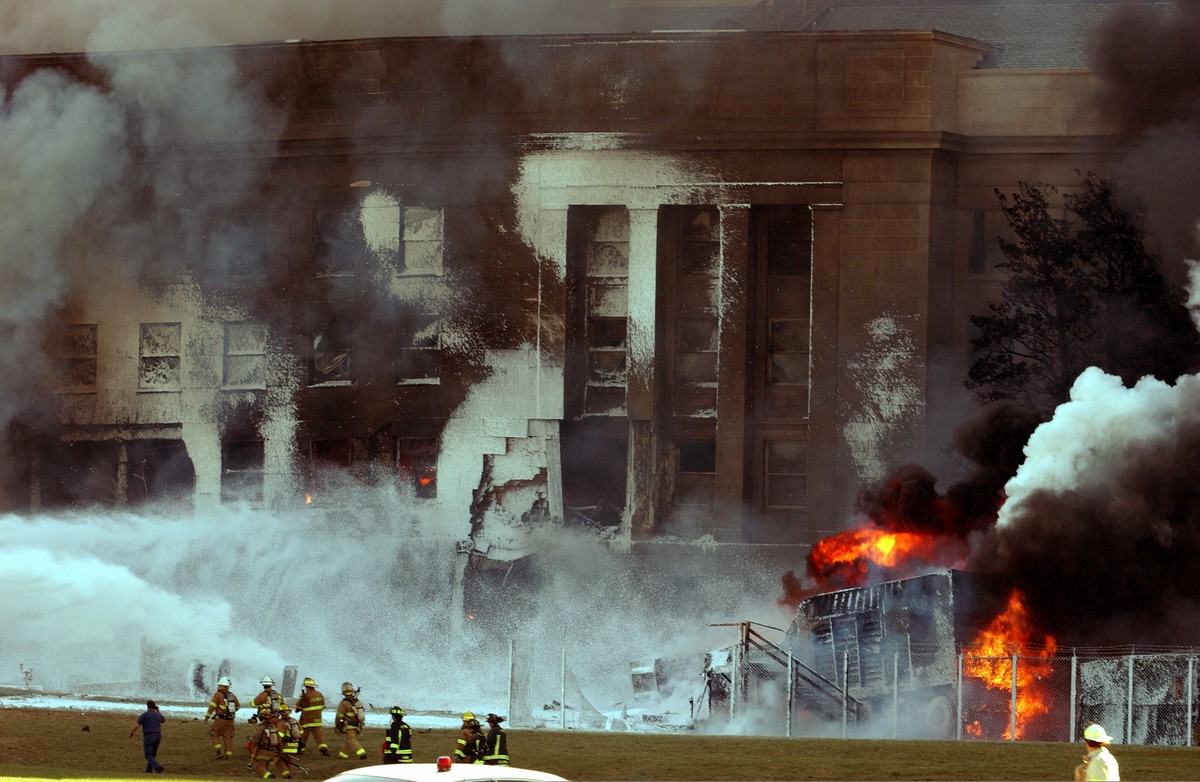
September 11, 2001 began as one of the clearest mornings of the year. Across Northern Virginia, the rituals of a working Tuesday unfolded the way they always did. Commuters inched up Interstate 395 toward the 14th Street Bridge. Slug lines formed in Springfield commuter lots, strangers pairing up for the HOV lanes the way they had for decades. Blue and Yellow Line trains slid into the Pentagon station, then the busiest transit hub in Virginia. At 7:45 a.m., an Air Force reservist named Kirk Foster rode his commuter shuttle along its usual route, passing within fifty yards of the Pentagon’s heliport on his way to a training course in Rosslyn.
By 9:37 a.m. that ordinary commute had become the region’s dividing line: the route thousands of Northern Virginians were traveling, or had just finished traveling, when American Airlines Flight 77 came down over I-395 and struck the building at the center of it all. This exhibit gathers what the official record established and what ordinary commuters, teachers, office workers, and firefighters wrote down afterward, so that twenty-five years later their voices carry the memory.
I’ve told people that judging from my bus route’s regular path, relative to the final path of the plane, I missed being killed by about 90 minutes.
Kirk Foster, Major, USAFR, of Springfield, in an account contributed to the September 11 Digital Archive, 2002
9:37 a.m.
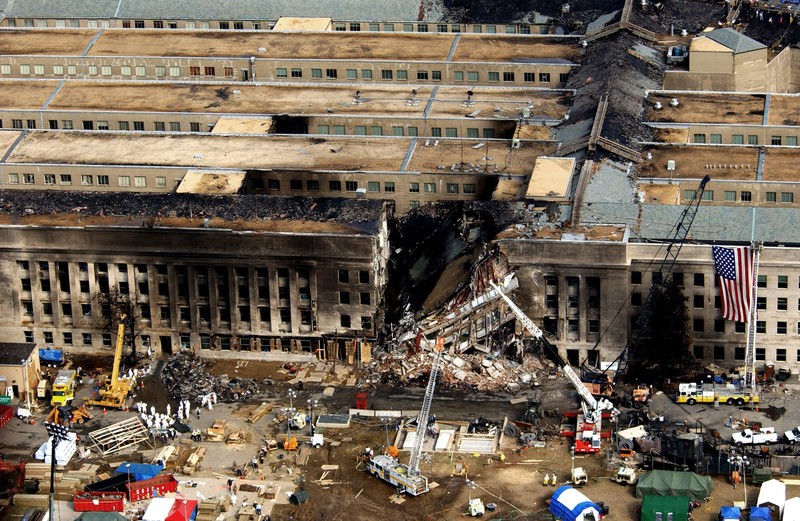
American Airlines Flight 77 left Dulles International Airport at 8:20 a.m. bound for Los Angeles, carrying sixty-four people including five hijackers. According to the Defense Department’s official history, Pentagon 9/11, the hijackers seized the plane over eastern Kentucky, turned it back toward Washington, and struck the Pentagon’s west wall at 9:37 a.m. The attack killed 184 victims: 125 people inside the building and all 59 passengers and crew aboard the plane.
The plane hit Wedge 1, the one section of the building that had just been renovated. It was five days from official completion. Its new blast-resistant windows and reinforced walls held long enough to matter: the damaged section of the outermost E Ring stood for almost forty minutes before collapsing at 10:15 a.m., a delay the official history credits with saving the lives of occupants on the upper floors. In West Springfield, a high school teacher whose husband was commuting up I-395 at that moment later wrote that the plane passed directly over his car. In a Pentagon City high-rise, a graduate student named Kevin Malecek heard what “sounded as if thousands of train locomotives past by my window” [sic] and watched the streets below fill with people running from the smoke.
We felt the impact, and we knew what it was. The building around us shook, but nothing collapsed on us. Thank God for the engineers and engineering of the Pentagon.
A military servicemember working in Pentagon room 5A324, who directed traffic off the I-395 ramp and then walked home along Columbia Pike. September 11 Digital Archive, 2003
Arlington County’s Response
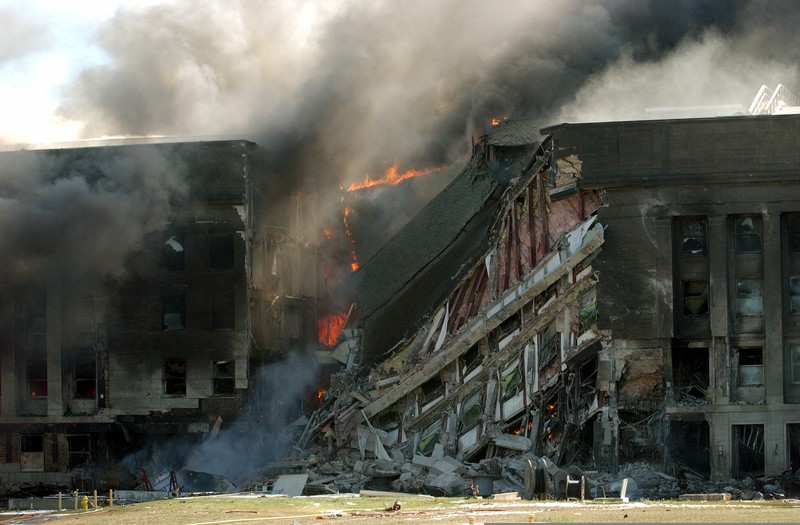
The Pentagon is federal property, but the emergency that morning belonged to Arlington County. Assistant Fire Chief James Schwartz of the Arlington County Fire Department reached the scene within ten minutes of impact and put the incident command system into effect, and the county fire department took command of the response. It held that command for ten days, until the fire was officially declared extinguished, and relinquished the site to the FBI on September 21.
The county’s after-action review ran to 92 debriefing sessions with roughly 475 participants from the fire, medical, law enforcement, and emergency management agencies that converged on the building under the region’s mutual-aid agreements. The 9/11 Commission later wrote that the emergency response at the Pentagon was “mainly a success,” crediting the professional relationships among the region’s responders, the incident command system, and the regional approach that Arlington and its neighbors had practiced for years. Around the firehouses, the county answered in smaller ways too. One Arlington resident who had felt her house shake that morning spent the evening packing supplies at the Salvation Army on South Glebe Road until 1:30 a.m.
Late Tuesday afternoon I roused myself enough to bake a pan of brownies and take them over to the fire station in Crystal City.
An Arlington resident who lived a mile from the Pentagon. September 11 Digital Archive, 2002
The Evacuation
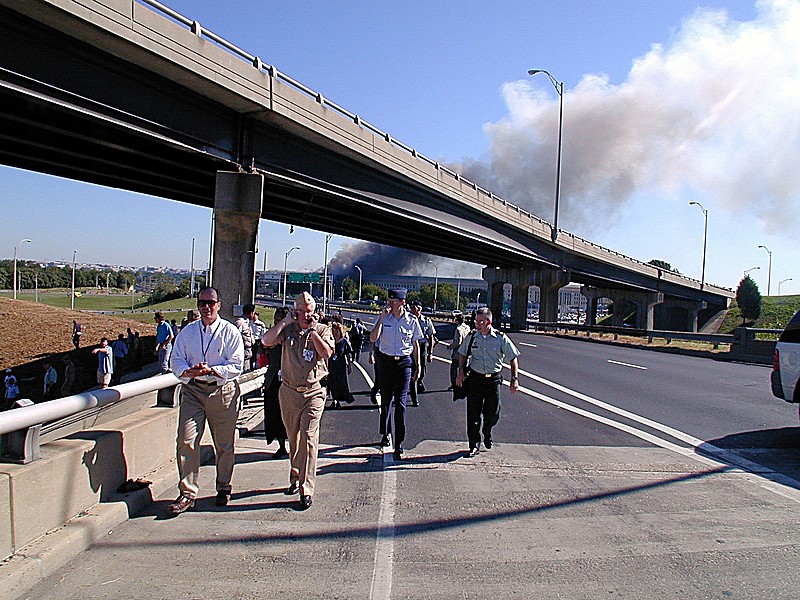
No official ever ordered the evacuation of downtown Washington. People simply left, all at once. Federal transportation officials interviewed afterward described sidewalks so crowded that pedestrians spilled into roadways where vehicles sat gridlocked and at a virtual standstill. The Virginia Department of Emergency Management closed all northbound lanes of I-395 from the Capital Beltway to the District line while the Pentagon burned. National Airport was evacuated. Thousands of Pentagon workers walked out of the building and down the interstate itself, a river of people on a highway built for cars.
On the George Washington Memorial Parkway, National Park Service rangers took in the children of the Pentagon’s day care center, who had been evacuated across the north parking lot and a footbridge to the Lady Bird Johnson Memorial Grove. A ranger closed a lane of the parkway and set up a perimeter around the children; by 5:30 p.m. every child had been reunited with family. For everyone else, the way home was improvised: shared cars, borrowed rides, long walks up Columbia Pike. Kirk Foster made it back to Springfield because a stranger’s carpool happened to be going his way.
And Shirley Highway, that bustling, always busy thoroughfare from Washington to points south, was totally empty except for the few cars like ours that was leaving the city to try and find safety and solace in our homes with our loved ones. [sic]
An office worker who watched the Pentagon burn from her building’s eighth-floor terrace, then drove south past it on I-395. September 11 Digital Archive, 2002
The Metro Stayed Open
One of the strangest facts of the day is that the region’s best way out was the one most people believed was closed. Metrorail never shut down. Only two stations closed, Pentagon and National Airport, both for security. From 10:41 a.m. trains ran through the Pentagon station without stopping, and Blue Line service was restored within minutes on that basis. But somewhere in the chaos, word spread that the whole system had stopped.
The U.S. Department of Transportation’s official study of the day, published in 2002, found that Metrorail carried 445,038 riders between opening and 6 p.m., about 40,000 fewer than the Tuesday before, on a day when the system was running rush-hour service and could have carried far more. The people packed onto the trains that did run remember them vividly. A State Department contractor wrote that his usual thirty-minute ride home took more than an hour and a half, in cars crammed with people desperate to learn whether their families in New York or at the Pentagon were alive.
Word also got around that the Metrorail service had been shut down, when in fact only the Pentagon and National Airport stations had been closed. This rumor, however, kept many people out of the subway and instead on the streets, heading home on foot.
Effects of Catastrophic Events on Transportation System Management and Operations, U.S. Department of Transportation, 2002
The 184
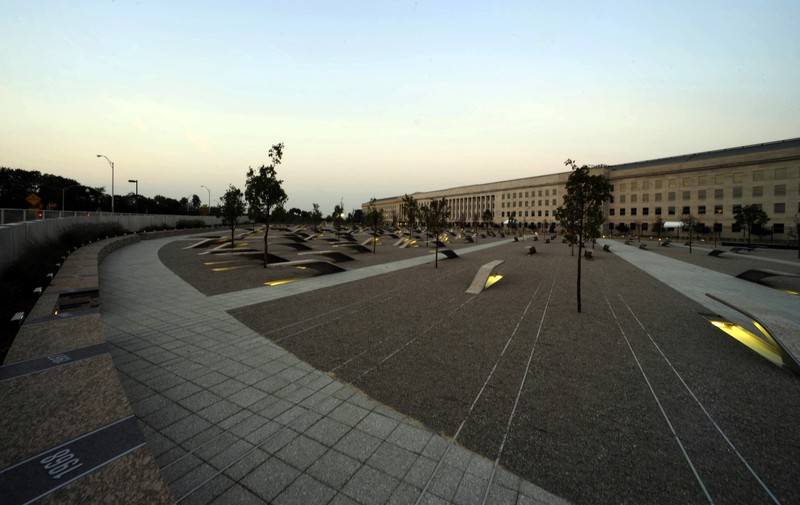
The National 9/11 Pentagon Memorial was dedicated on September 11, 2008, on two acres beside the building’s west wall, in Arlington. It holds 184 memorial units, one for each victim: a cantilevered bench over a small lighted pool of moving water, each bearing a name. The units are arranged along age lines by year of birth, from Dana Falkenberg, a three-year-old passenger on Flight 77, to John D. Yamnicky, a seventy-one-year-old Navy veteran aboard the same plane.
The design carries the geography of the day inside it. Benches for the 125 people killed in the building face one way, so a visitor reading the name sees the Pentagon behind it. Benches for the 59 people aboard the plane face the other, aligned with the aircraft’s approach. The memorial’s zero line is etched with a single inscription: September 11, 2001, 9:37 a.m.
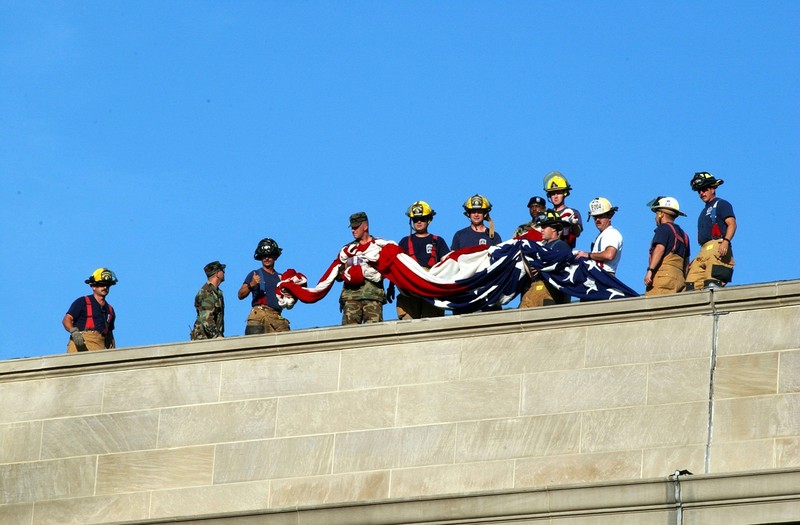
As we were passing the ‘Pentagon’ my wife and others drivers on I-395 had the opportunity to see the Firefighters and other rescuers lower the ‘American Flag’ over the side of the ‘Pentagon’ [sic]
A State Department contractor describing the drive past the building on the night of September 11. September 11 Digital Archive, 2006
How a Region Remembers
Northern Virginia did not only live this history. It built much of the infrastructure that preserves it. Within months of the attacks, George Mason University’s Center for History and New Media, working with partners at the City University of New York, created the September 11 Digital Archive, collecting more than 40,000 firsthand written accounts and 150,000 digital files from ordinary people. In September 2003 the Library of Congress accepted a copy of the archive into its permanent collections, the Library’s first major digital acquisition. Nearly every firsthand voice in this exhibit comes from that archive, gathered by a university eighteen miles from the building.
The remembering continued in layers. Arlington Public Library’s Center for Local History recorded oral histories with residents and first responders around the fifth anniversary, and its community archives hold the thank-you cards Arlington schoolchildren sent to the county’s firefighters. In 2008, StoryCorps recorded more than thirty stories at the Pentagon from staff and victims’ families, now preserved at the Library of Congress. The Defense Department’s historians built the official account, Pentagon 9/11, from more than 1,300 oral history interviews. And in 2026, for the 25th anniversary, the 9/11 Legacy Foundation began releasing the Pentagon Response Series, long-unseen footage shot by a documentary crew that had been filming a fire training video that morning and spent three days embedded with the Arlington County Fire Department.
Our neighborhood is very friendly people but nobody ever seems to talk to anybody else. But on that day everybody was outside of their house.
Elizabeth Davis, Arlington resident, in a 2006 interview for Arlington Public Library’s Remembering September 11 oral history collection
Share Your Memory
If you lived in Northern Virginia on September 11, 2001, you carry a piece of this story: where you were when the smoke rose over Arlington, how you got home, who you waited for. Twenty-five years on, those ordinary details are exactly what the historical record is made of. We invite you to record your memory of that day in your own voice for NovaMuseum, and to explore the collections above, beginning with the September 11 Digital Archive, where the voices in this exhibit remain preserved in full.
Sources and Image Credits
Firsthand accounts are quoted in short excerpts, with attribution and links, from the September 11 Digital Archive (Roy Rosenzweig Center for History and New Media, George Mason University, and American Social History Project/Center for Media and Learning, CUNY), items 4486, 7038, 11333, 14485, 14890, 15145, and 96969. Original contributors retain copyright over their accounts; original spelling and punctuation are preserved, marked [sic] where needed. One quotation is from Arlington Public Library’s Remembering September 11 oral history collection.
Factual record: Pentagon 9/11, Office of the Secretary of Defense Historical Office, 2007; Arlington County After-Action Report; The 9/11 Commission Report, chapter 9; Effects of Catastrophic Events on Transportation System Management and Operations, U.S. DOT, 2002; FHWA practitioner interviews; National Park Service, George Washington Memorial Parkway; National 9/11 Pentagon Memorial; 9/11 Legacy Foundation, Pentagon Response Series.
Photographs are United States government works in the public domain: U.S. Marine Corps photos by Cpl. Jason Ingersoll; U.S. Navy photos by Journalist 1st Class Mark D. Faram, Photographer’s Mate 1st Class Michael W. Pendergrass, and Mass Communication Specialist 1st Class Brien Aho; U.S. Air Force photo by Tech. Sgt. Cedric H. Rudisill.