
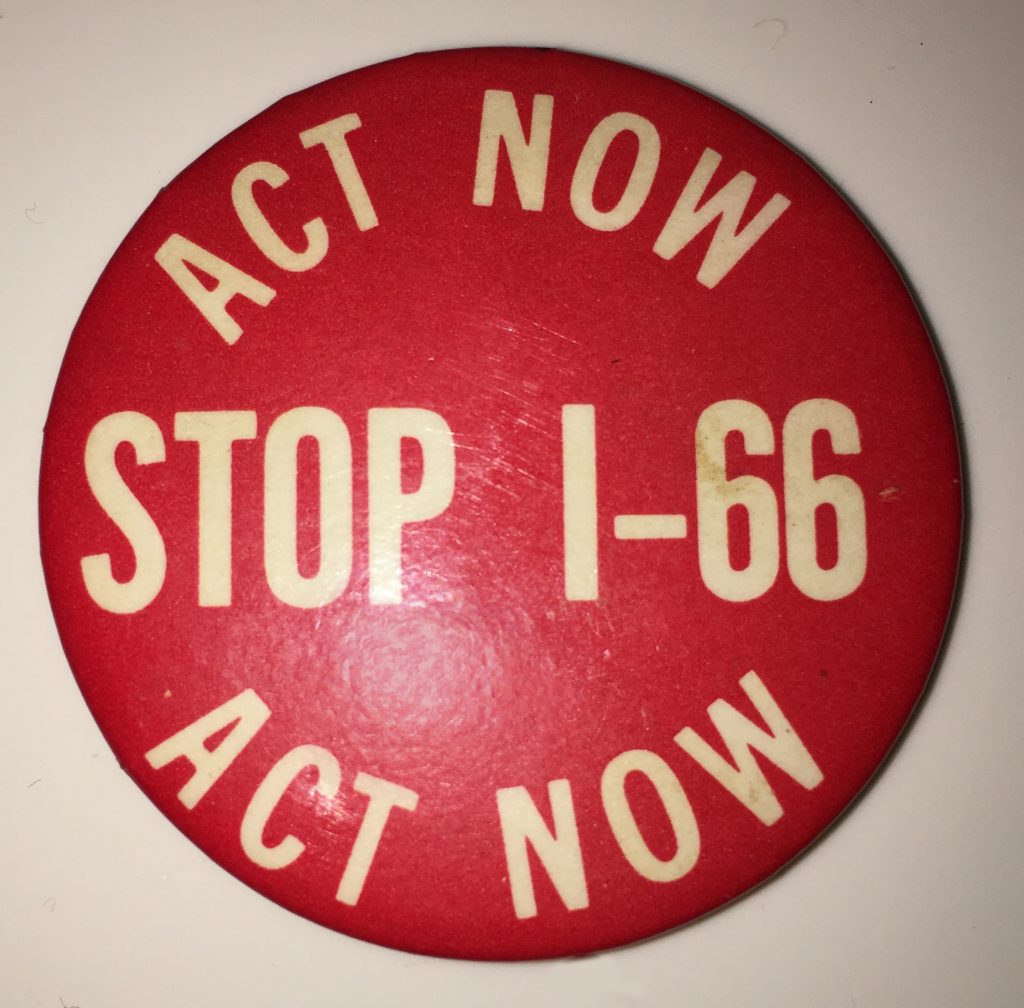
This protest pin represents one of the most bitter and prolonged civic battles in Arlington’s history—a decades-long fight against the construction of Interstate 66 that lasted from the late 1950s through the highway’s opening in 1982.
Originally proposed in 1956, I-66 was planned as a massive eight-lane highway connecting the Shenandoah Valley with Washington, D.C. Arlington residents faced the prospect of losing their homes through eminent domain, the destruction of tree cover and green space, and the division of their neighborhoods by what would have been a 12-lane corridor at some points.
The resistance movement, led by grassroots organizations like the Arlington Coalition on Transportation (ACT), represented a pivotal moment in American environmental activism. Protesters employed creative tactics—cutting “w” off “Build 66 Now” bumper stickers to read “Build 66 No,” lobbing paint-filled balloons at construction sites, and planting trees in cleared areas. These activists were among the first in the nation to leverage the newly passed National Environmental Policy Act of 1970, which required Environmental Impact Statements for federally funded projects.
The protests achieved remarkable success. What began as an eight-lane environmental disaster became a compromise four-lane highway with high-occupancy vehicle restrictions and six miles of Metrorail in the median—”one of the most innovative highways in American history,” according to Civil Engineering magazine. The movement cost $280 million (versus the original $25 million estimate) and required personal intervention from U.S. Transportation Secretary William Coleman.
This pin embodies a transformative moment when ordinary citizens successfully challenged massive infrastructure projects, setting precedents for community activism, environmental protection, and transportation planning that resonate today.
Read more about I-66 Protest Movement at the Arlington Historical Society
Gift of Robert and Christina Hoffman, [2005]